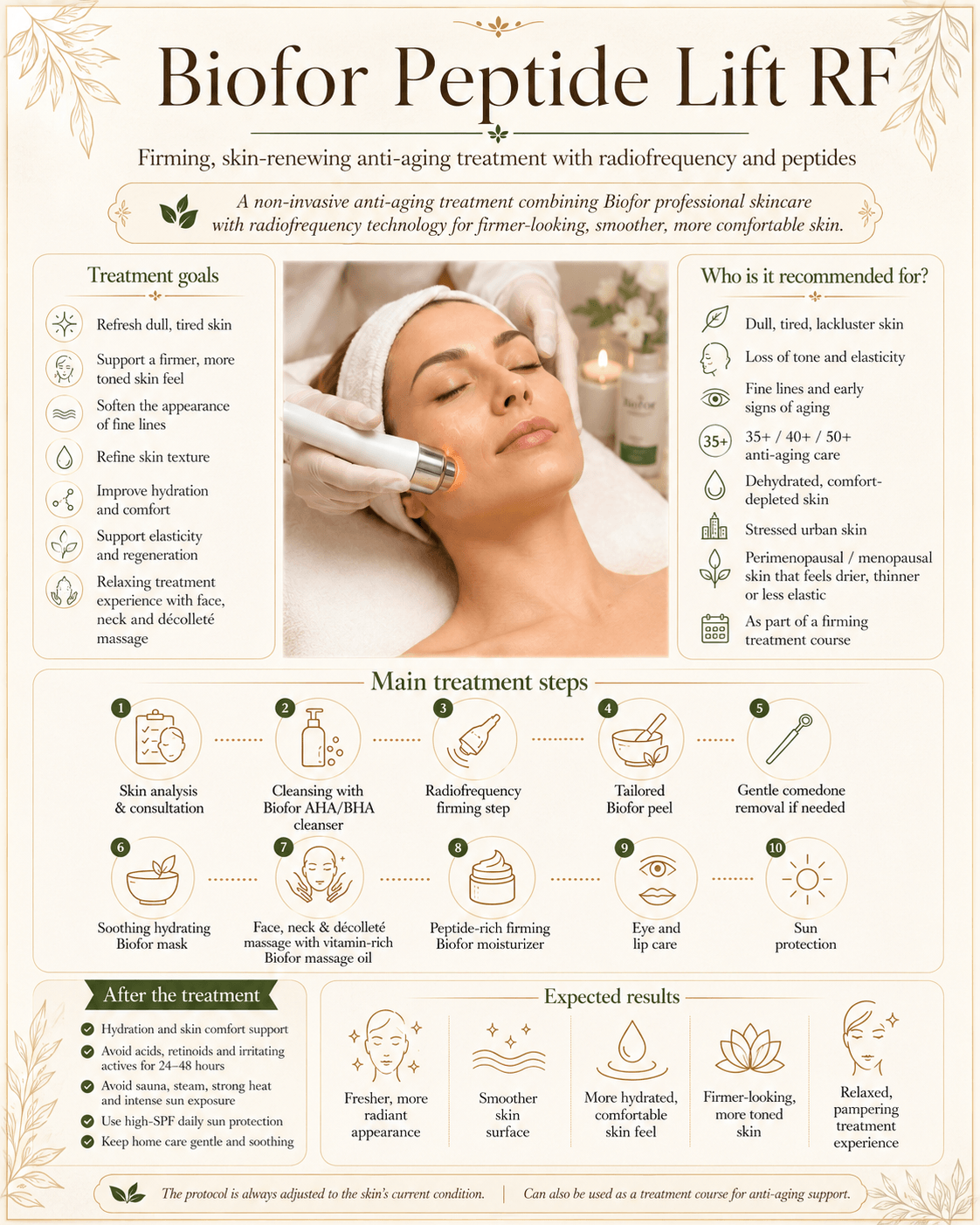
The Biofor Peptide Lift RF is an anti-aging, firming and skin-refreshing treatment that combines Biofor professional active ingredients with radiofrequency technology.
In this treatment, active ingredients and device-based technology work together in synergy: the controlled heat effect of radiofrequency supports a firmer skin feel and connective tissue processes, while Biofor products rich in peptides, vitamins and hydrating ingredients help provide regenerating, nourishing and comfort-enhancing care for the skin.
The aim of the treatment
The aim of the treatment is to:
The Biofor Peptide Lift RF treatment is a non-invasive anti-aging protocol in which the goal is not to over-stimulate the skin, but to create a balance between firming, hydration, regeneration and skin comfort.
Who is it recommended for?
The treatment is mainly recommended for the following skin conditions:
The treatment may also be a good choice when the guest’s skin appears more tired or less toned, but a more invasive skin-renewing procedure is not necessary or not desired.
When is it not recommended?
The treatment is not recommended, or should be postponed, in the following cases:
Treatment steps
The treatment always begins with an assessment of the skin’s current condition. I examine the skin’s hydration, sensitivity, elasticity, the character of fine lines, pores, loss of tone and any signs of irritation.
During the consultation, we also discuss the guest’s home skincare routine, especially the use of retinoids, acid exfoliants, strong vitamin C products, anti-acne actives and any recent cosmetic or medical-aesthetic treatments.
Based on this, it can be decided whether the radiofrequency step can be performed safely, what intensity should be used, and which Biofor skin-renewing, hydrating, soothing or peptide-rich direction best suits the guest’s skin.
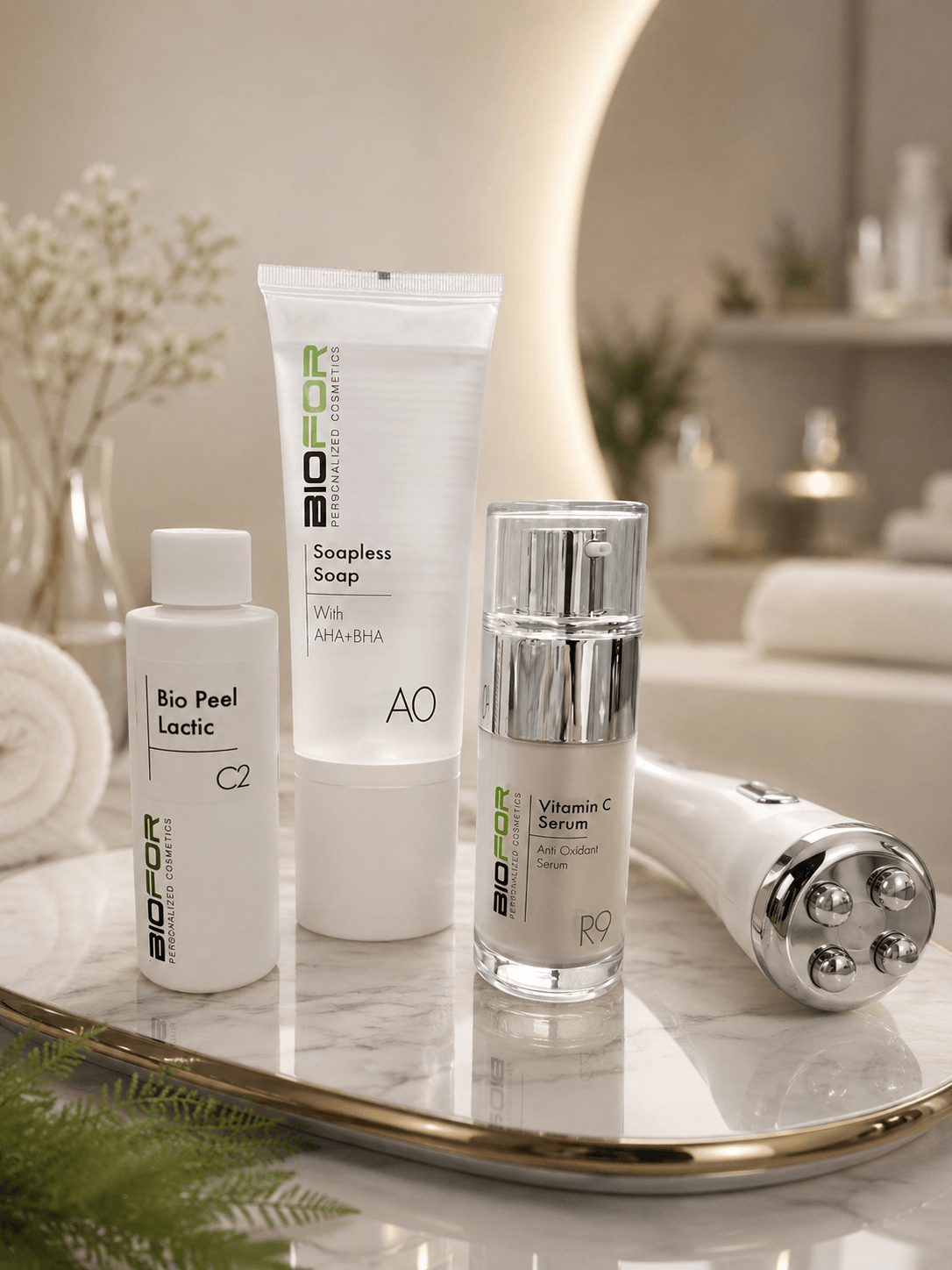
The first practical step of the treatment is thorough yet gentle cleansing. In this phase, I use a Biofor cleanser containing AHA and BHA.
AHA components help gently refresh the skin surface and loosen dead skin cells, while BHA-type ingredients may be especially useful in supporting a cleaner pore feel. The aim of the cleanser is not strong exfoliation, but preparation of the skin for the radiofrequency and active ingredient steps.
This phase helps remove makeup, sebum, sunscreen and impurities, while refreshing the skin without overloading it.
After cleansing, one of the central technological elements of the treatment follows: radiofrequency skin firming.
Radiofrequency creates a controlled heat effect in the deeper layers of the skin. This warming effect may provide a firmer skin feel in the short term, while in the longer term it may support connective tissue processes that play a role in maintaining skin elasticity and density.
During the treatment, the intensity is always adapted to the skin condition, sensitivity and the guest’s comfort. The aim is a pleasant, controlled warm sensation, not overheating or irritating the skin.
The radiofrequency step fits particularly well into this protocol, as it prepares the skin for the following active ingredient, regenerating and peptide-rich care.
After the radiofrequency step, a Biofor peeling selected according to the skin condition follows. The choice of peeling always depends on whether the skin is mainly dull, has a thickened stratum corneum, is dehydrated, more sensitive or uneven in tone.
The aim of the peeling is to gently remove dead skin cells, refine the skin surface and support a fresher, smoother skin feel. In this protocol, the peeling is not used as aggressive exfoliation, but as a controlled skin-preparation and skin-refreshing step.
For more sensitive, redness-prone skin or skin with a weakened barrier, the intensity of the peeling may be reduced, or a gentler preparation step may be chosen if necessary.
If the skin condition requires and allows it, the treatment may include the careful removal of blackheads and comedones.
This step is not necessary for every guest. The Biofor Peptide Lift RF is primarily an anti-aging, firming and regenerating treatment, so the cleansing/extraction step is included only when it fits the skin condition and the aim of the treatment.
After the skin-renewing and radiofrequency steps, a soothing, hydrating Biofor mask follows. Its purpose is to improve skin comfort, reduce the feeling of tightness, support hydration and help calm possible redness.
An important part of the treatment is a pleasant, relaxing face, neck and décolleté massage, performed with a vitamin-rich Biofor massage oil.
The aim of the massage is to enhance skin comfort, support circulation and lymphatic flow, and provide the guest with a relaxing, replenishing treatment experience. Slow smoothing movements, gentle lymphatic techniques and relaxing massage motions may help the face appear fresher and more rested.
The vitamin-rich massage oil has a nourishing, skin-softening and comfort-enhancing role. It helps the skin feel softer, more supple and well cared for by the end of the treatment.
The intensity of the massage is always adapted to the skin condition. For more sensitive or redness-prone skin, I use a gentler and shorter massage, while for skin in good condition with loss of tone, more pronounced lifting-style movements may also be included.
After the massage, a peptide-rich, firming Biofor moisturising cream is applied to the skin. This step is one of the most important finishing elements of the treatment’s anti-aging character.
Peptides are important active ingredients in modern cosmetic anti-aging care. In cosmetic use, they are applied to support skin comfort, elasticity, a firmer skin feel and a more regenerated appearance. The aim of the moisturising cream is to help maintain skin hydration, support a softer, fuller skin feel and elegantly complete the radiofrequency, peeling and massage protocol.
This phase is not only a hydrating finish, but also reinforces the professional focus of the treatment: at the end, the skin receives targeted, firming, peptide-rich care.
As a delicate complementary step, special attention is given to the eye area and the lips. These zones are thinner and more sensitive, can become dehydrated more easily and often show signs of fatigue sooner.
Targeted eye and lip care helps the area feel more hydrated, fresher and more comfortable, while contributing to a fresh and harmonious overall appearance.
During daytime, the treatment is finished with sun protection. Since the protocol includes skin-refreshing peeling and active ingredient care, UV protection is especially important.
The finishing sunscreen is always selected according to the guest’s needs and the current condition of the skin. If the aim is a light, natural finish, I apply a high-protection sunscreen. If the guest would also like light coverage and a more even-looking complexion, a BB cream-type finish may also be chosen.
Home care after the treatment
After the Biofor Peptide Lift RF treatment, the aim of home care is to hydrate, soothe and protect the skin, and to support the results of the treatment.
For 24–48 hours after the treatment, it is advisable to avoid:
Recommended home routine:
If the skin is slightly redder or warmer after the treatment, this may be a temporary reaction. In this case, the home routine should be kept simple: gentle cleansing, hydration and sun protection.
Course of treatments
The Biofor Peptide Lift RF treatment can provide a visible refreshing and firming experience as a standalone treatment, but for anti-aging purposes it can also be used as a course.
In a course of treatments, the frequency is always determined by the condition and sensitivity of the skin, as well as the guest’s goals. Over the course, the skin may gradually feel more hydrated, more comfortable, fresher and firmer.
Duration: 90 minutes
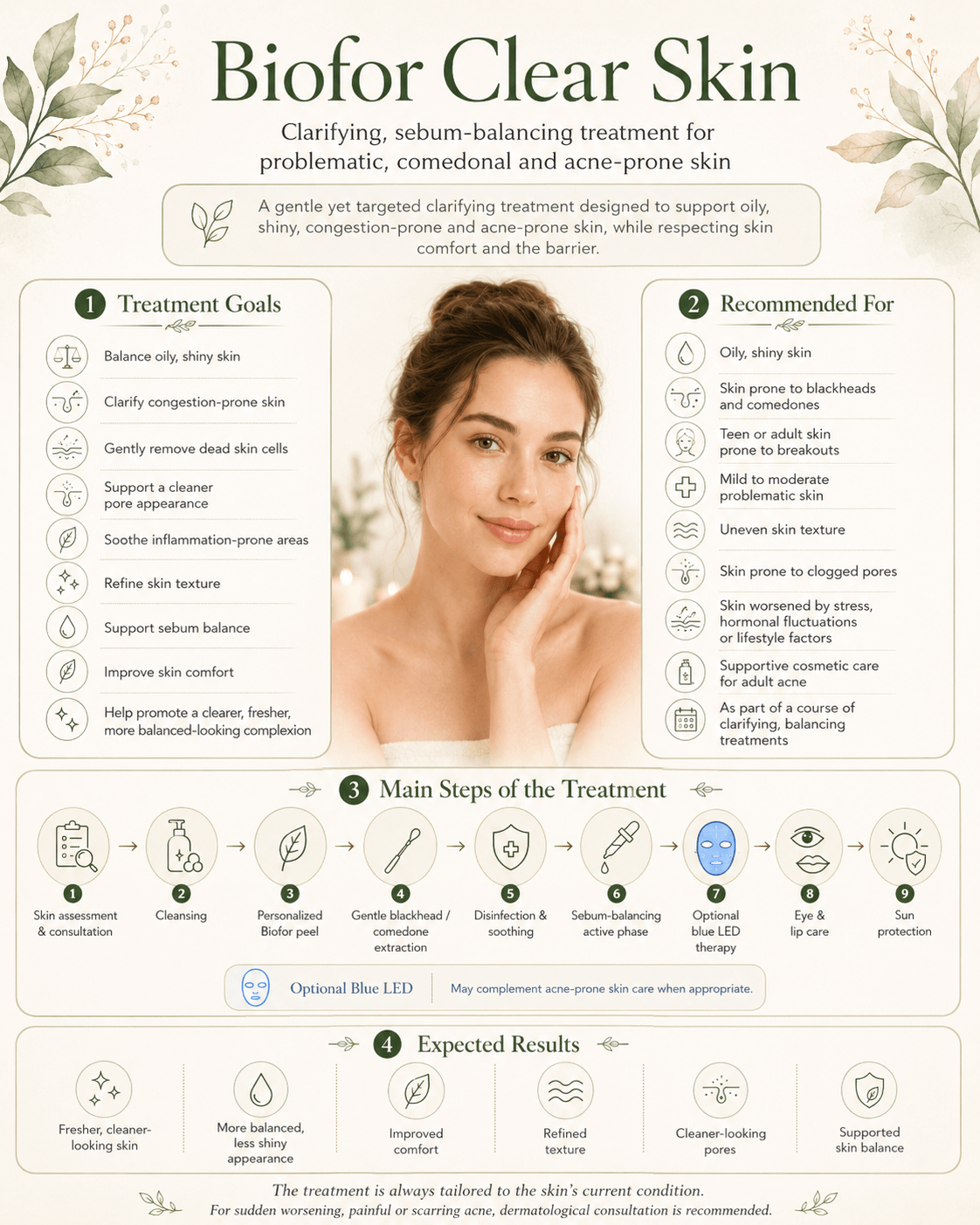
The Biofor Clear Skin is a gentle yet targeted purifying and skin-balancing treatment, recommended primarily for oilier, shiny skin that is prone to comedones and breakouts.
The care of problematic skin is a complex process. Increased sebum production, clogged pores, the accumulation of dead skin cells, a tendency to inflammation and a vulnerable skin barrier are often present at the same time. For this reason, the Biofor Clear Skin treatment is built on cleansing, exfoliating, sebum-balancing, soothing and hydrating steps that work together.
This treatment may be an especially good choice for those whose skin is prone to blackheads, comedones and occasional breakouts, but does not tolerate overly strong, drying or irritating anti-acne treatments well.
The aim of the treatment
The aim of the treatment is to:
Biofor Clear Skin is not a “drying” treatment. It is a protocol designed for problematic skin that targets cleansing, skin renewal, soothing and hydration at the same time.
Who is it recommended for?
The treatment is mainly recommended for the following skin conditions:
In adult acne, careful skin assessment is especially important, as inflammation, dehydration, barrier damage and hormonal factors are often present at the same time.
When is it not recommended?
The treatment is not recommended, or should be postponed, in the following cases:
In the case of severe, scarring, suddenly worsening or painful acne, cosmetic treatment alone is not sufficient; dermatological consultation is recommended.
Treatment steps
The treatment always begins with an assessment of the skin’s current condition. I examine how oily, comedone-prone, inflammation-prone, dehydrated, sensitive or barrier-weakened the skin is.
During the consultation, we also discuss the guest’s home skincare routine. Special attention is given to whether the guest uses acid exfoliants, retinoids, benzoyl peroxide, strong vitamin C products, drying anti-acne products or dermatologist-prescribed preparations.
Based on this, it can be decided how intensive the treatment can be, whether comedone removal is needed, whether peeling can be used, and which soothing and sebum-balancing Biofor steps best suit the condition of the skin.
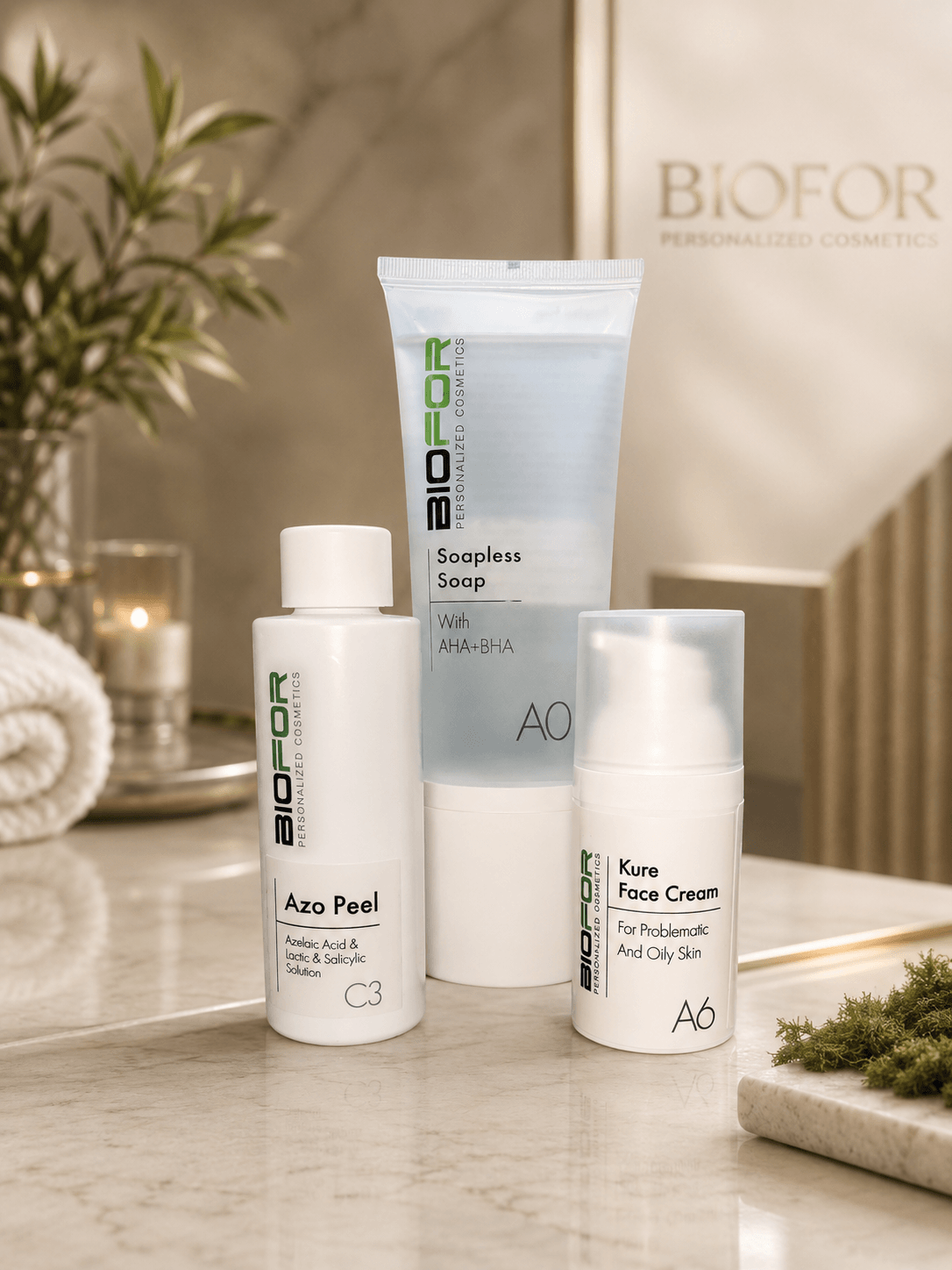
The first practical step of the treatment is thorough but gentle cleansing. In this phase, I use a Biofor cleanser containing AHA and BHA.
AHA ingredients help gently refresh the skin surface and loosen dead skin cells, while BHA-type ingredients fit particularly well into the care of oilier skin prone to clogged pores. The aim is effective cleansing, but not over-drying or irritating the skin.
In problematic skin, it is especially important that cleansing is effective, while still protecting the skin’s barrier.
The next step is a Biofor peeling adapted to the current skin condition. Its aim is to gently remove dead skin cells, reduce pore congestion, refine the skin surface and support a fresher, cleaner skin feel.
In problematic skin, controlled exfoliation is especially important. Too strong or too frequent exfoliation can worsen skin comfort, increase redness and weaken the barrier. For this reason, the strength of the peeling is always adapted to the skin’s current condition.
If the condition of the skin allows it, the treatment may include the careful removal of blackheads and comedones.
This step is always skin-condition dependent. It is not necessary in every case, and not every skin is suitable for it at the given moment. I do not perform mechanical extraction on inflamed, painful, purulent or highly irritated acne lesions, as this may worsen the condition and increase the risk of irritation, secondary infection or post-inflammatory pigmentation.
The aim is gentle pore cleansing, not excessive mechanical stress on the skin.
After cleansing and extraction, skin disinfection is especially important.
This is followed by soothing the skin, improving comfort and avoiding further irritation. In the treatment of problematic skin, calming steps are just as important as the cleansing or exfoliating phases.
In the next step, Biofor active ingredients adapted to the skin condition are used to support sebum balance. The aim is to help balance oily, shiny skin, support a cleaner pore feel and soothe skin prone to inflammation.
At this stage, active ingredient directions that fit the treatment well include those that support:
In problematic skin, it is not enough to reduce sebum alone; hydration and protection of the skin barrier are also necessary for the skin to become more balanced in the long term.
The Biofor Clear Skin treatment may also be complemented with blue LED light therapy, if the skin condition and contraindications allow it.
The cosmetic significance of blue LED light lies in its ability to act on the light-sensitive porphyrins produced by Cutibacterium acnes, a bacterium involved in acne development. Blue light can activate these molecules, which may lead to the formation of reactive oxygen species. This can create an unfavourable environment for the bacteria, making blue LED a useful complementary step in the care of acne-prone skin.
Eye protection is required during the LED treatment.
As a delicate complementary step, special attention is given to the eye area and the lips. These zones are thinner and more sensitive, can become dehydrated more easily, and often show signs of fatigue sooner.
Targeted eye and lip care helps the area feel more hydrated, fresher and more comfortable, while contributing to a well-groomed and harmonious overall appearance.
During daytime, the treatment is finished with sun protection. Problematic, acne-prone skin also needs UV protection, especially if the treatment included peeling or extraction, or if the skin is prone to post-inflammatory marks.
The sunscreen is always selected according to the current condition of the skin and the guest’s needs. For oilier skin prone to pore congestion, a lighter, non-comedogenic-feeling sunscreen finish is recommended. If the guest would like light coverage and a more even-looking complexion, a BB cream-type finish may also be chosen, taking the skin condition into account.
Home care after the treatment
After the Biofor Clear Skin treatment, the aim of the home routine is to soothe and hydrate the skin, protect the barrier and provide consistent care that helps avoid clogged pores.
For 24–48 hours after the treatment, it is advisable to avoid:
Recommended home routine:
Problematic skin responds best when salon treatment and the home routine support each other. For this reason, every treatment includes home care advice tailored to the current condition of the skin.
Course of treatments
The Biofor Clear Skin treatment can help give the skin a fresher, cleaner and more comfortable feel even as a standalone treatment, but for acne-prone, comedone-prone or oily skin, it may be most effective when used as a course of treatments.
In a course, the frequency of treatments always depends on the condition and sensitivity of the skin, as well as the guest’s home skincare routine. The goal is gradual skin balancing, not excessive exfoliation or drying.
Duration: 90 minutes
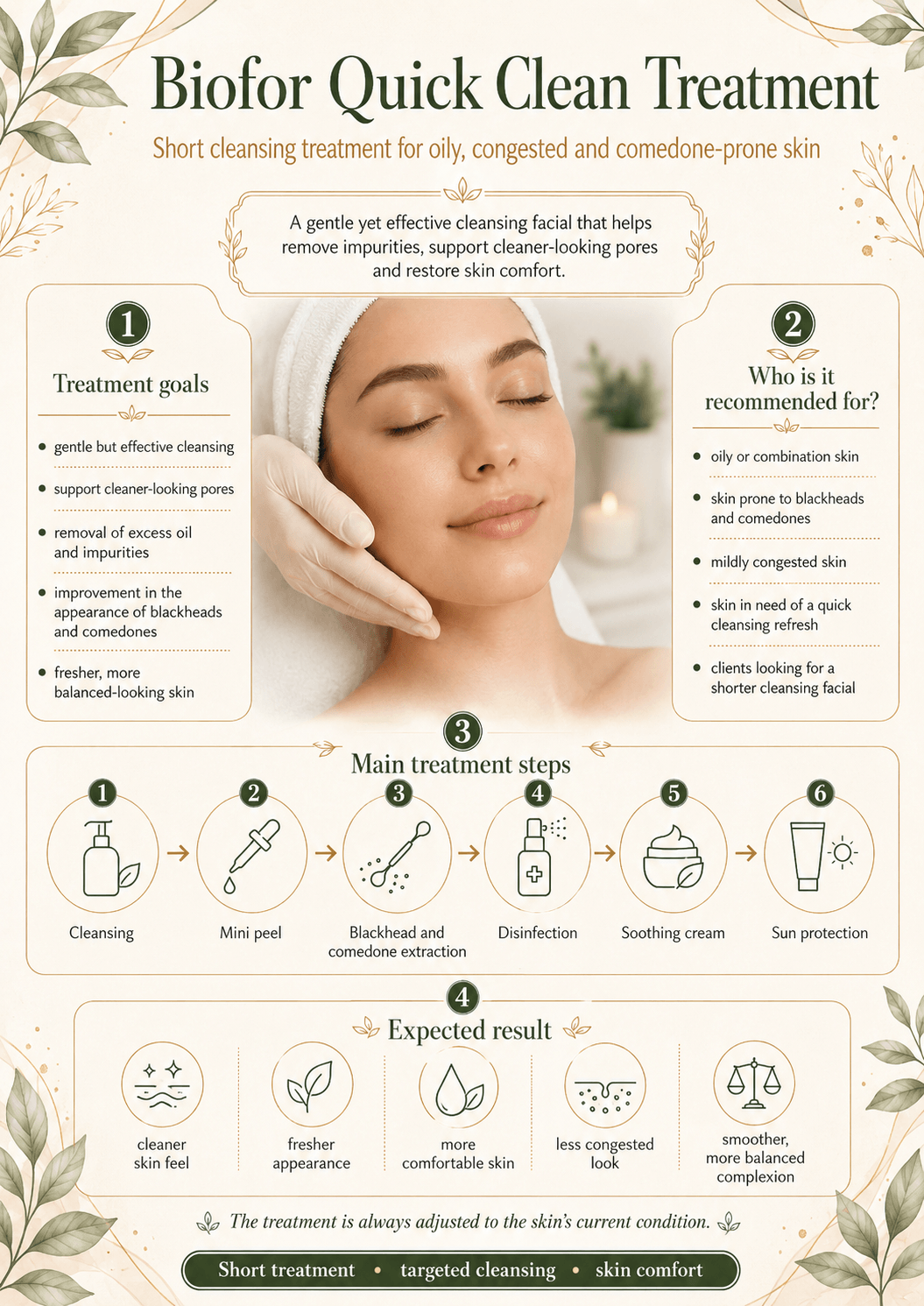
The Biofor Quick Clean is a shorter, targeted cleansing treatment recommended primarily for skin prone to comedones, blackheads and clogged pores. The aim of the treatment is to cleanse the skin thoroughly yet gently, delicately remove dead skin cells, carefully extract blackheads and comedones, then soothe and protect the skin.
This treatment is not an intensive acne treatment and not a complex skin renewal protocol. It is a shorter, practical, cleansing-focused treatment that can be easily integrated into a regular skincare programme.
The aim of the treatment
The aim of the treatment is to:
Who is it recommended for?
The treatment is mainly recommended for the following skin conditions:
When is it not recommended?
The treatment is not recommended, or should be postponed, in the following cases:
In cases of severe, rapidly worsening, painful or scarring acne, dermatological consultation is recommended.
Treatment steps
The treatment begins with a short assessment of the skin’s current condition. I check how comedone-prone, blackhead-prone, oily, dehydrated, sensitive or irritated the skin is.
Based on this, it can be decided whether the skin is suitable for mechanical cleansing, what strength of mini peel can be used, and whether the treatment needs to be adjusted in a gentler direction.
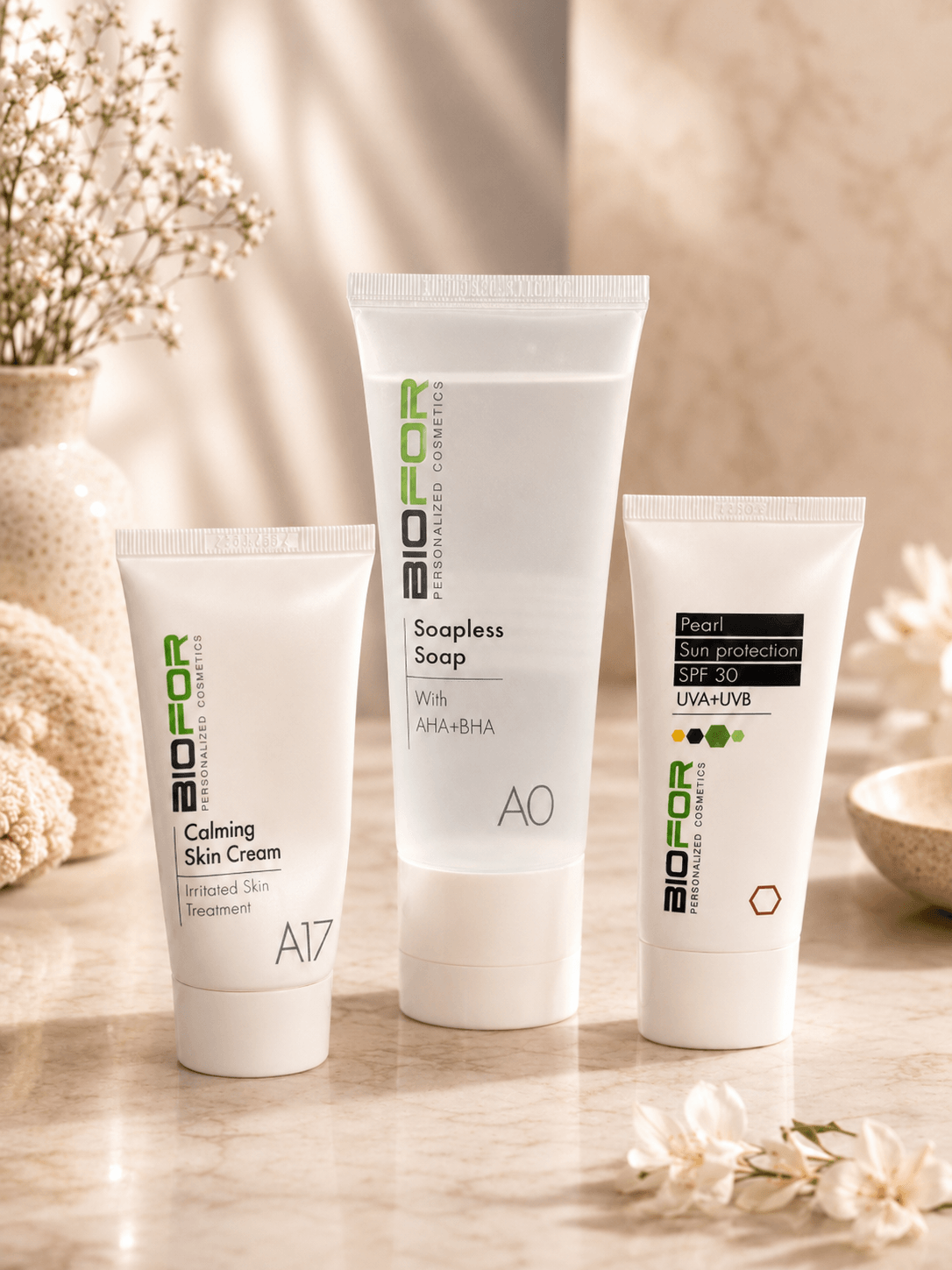
The first step of the treatment is thorough but gentle cleansing with a Biofor cleanser. The aim is to remove makeup, sebum, sunscreen and impurities without unnecessarily drying or irritating the skin.
In comedone-prone and oilier skin, thorough cleansing is especially important, as sebum, dead skin cells and external impurities can together contribute to clogged pores.
Cleansing is followed by a short, skin-condition-specific mini peel. The aim of the mini peel is to delicately remove dead skin cells, prepare the skin surface and make the cleansing/extraction step easier.
In this treatment, the peel is not an intensive skin-renewing step, but a gentle preparation for removing comedones and blackheads. Its strength is always adapted to the current condition of the skin.
For more sensitive, redness-prone or over-exfoliated skin, the peel is performed in a gentler form or may be omitted if necessary.
The central step of the treatment is the careful and hygienic removal of comedones and blackheads. This step is always skin-condition dependent and is performed only on areas where the skin condition safely allows it.
The aim is not aggressive squeezing, but gentle pore cleansing. I do not extract inflamed, painful or purulent acne lesions, as this may worsen the skin condition, increase irritation and raise the risk of post-inflammatory pigmentation.
After mechanical cleansing, a disinfecting step follows. Its purpose is to hygienically close the freshly cleansed skin surface and protect areas that may have become temporarily more sensitive after extraction.
This phase is especially important after removing blackheads and comedones, as the skin may be more reactive for a short time.
After disinfection, a soothing, comfort-enhancing Biofor cream is applied to the skin. Its purpose is to reduce redness after cleansing, ease the feeling of tightness and restore skin comfort.
When treating problematic or comedone-prone skin, it is important not to leave the skin dry or unprotected after cleansing. The right soothing finish helps the skin feel cleaner while remaining more comfortable.
During daytime, the treatment is finished with sun protection. After cleansing and a mini peel, the skin may react more sensitively to UV radiation, so sunscreen is an important part of the protocol.
The sunscreen is selected according to the condition of the skin. For oilier skin prone to clogged pores, a lighter, non-comedogenic-feeling sunscreen finish is recommended.
Home care after the treatment
After the Biofor Quick Clean treatment, the aim of the home routine is to soothe and hydrate the skin and maintain consistent care that helps avoid clogged pores.
For 24–48 hours after the treatment, it is advisable to avoid:
Recommended home routine:
Duration: 60 minutes
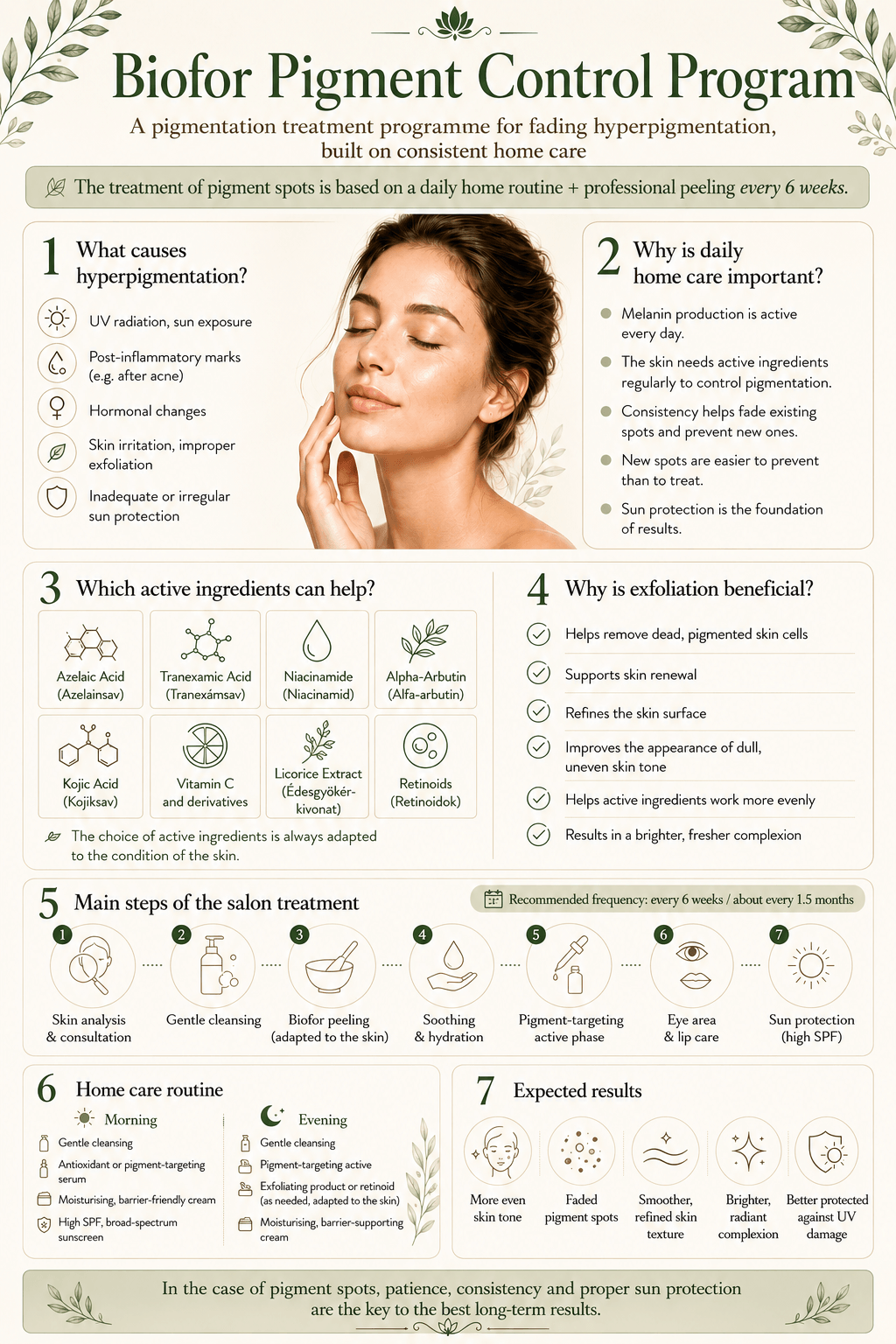
The Biofor Pigment Control Program is a treatment approach designed for hyperpigmentation, uneven skin tone and pigment spots, with consistent home skincare at its centre. Treating pigment spots does not depend on a single salon treatment: the skin needs to receive, regularly and ideally every day, the active ingredients that support the regulation of melanin production, the gradual fading of pigment spots and the prevention of new spots.
In this programme, salon treatment plays an important complementary role: a professional peeling treatment performed approximately every six weeks, or about every month and a half, can support skin renewal, the removal of dead skin cells and the development of a more even, radiant complexion.
The aim of the programme is therefore not only to fade existing pigment spots, but also to help the skin become more balanced, more even-toned and better protected from UV exposure in the long term.
Hyperpigmentation occurs when melanin production increases in certain areas of the skin, or when pigment is distributed unevenly within the epidermis. Melanin is the skin’s natural pigment and has an important protective role, as it helps protect the skin from the damaging effects of UV radiation.
A problem develops when the pigment-producing cells, the melanocytes, become overly active and pigment is deposited unevenly. This can lead to brown spots, sun spots, post-inflammatory pigmentation or an uneven skin tone.
Pigment spots can develop for several reasons. The most common triggering and maintaining factors include:
One of the most important factors maintaining pigment spots is UV radiation. For this reason, in a pigmentation treatment programme, sun protection is not an optional extra step, but one of the fundamental conditions for achieving and maintaining results.
Hyperpigmentation can be addressed at several points. The aim is to:
For this reason, the treatment of pigment spots is built on three main pillars:
Why is daily home care important?
Treating pigment spots requires a consistent home routine because melanin production does not happen only on the day of the salon treatment. Every day, the skin is exposed to factors that can increase pigment formation: UV radiation, visible light, heat, inflammation, irritation or hormonal influences.
This is why active ingredients that help regulate melanin production should be used regularly, ideally on a daily basis. These ingredients do not “erase” spots immediately; instead, they gradually help reduce the amount of newly produced pigment, support a more even skin tone and slowly fade existing spots.
Fading pigment spots requires patience. It usually takes several weeks, and often several months, for the skin tone to become visibly more even. In this process, consistency is more important than a single intensive treatment.
Which active ingredients can help?
Several groups of active ingredients can be used in the care of pigment spots. They influence the pigmentation process at different points.
Active ingredients that help regulate melanin production
These active ingredients can help reduce or regulate the process of melanin production:
The choice of active ingredients always depends on the condition of the skin. Sensitive, rosacea-prone skin needs a different routine than post-acne marks, and sun-damaged, more mature skin requires another approach.
Why is exfoliation beneficial for pigment spots?
Some pigment spots are more visible in the upper layers of the epidermis. Gentle, controlled exfoliation helps remove dead, pigmented skin cells, so the skin surface may gradually appear fresher, smoother and more even-toned.
The benefits of exfoliation for pigment spots include:
However, in skin prone to pigmentation, exfoliation that is too strong, too frequent or incorrectly applied can have the opposite effect: it may cause irritation, inflammation, barrier damage and even new pigmentation. For this reason, exfoliation should always be controlled and adapted to the skin’s current condition.
The role of salon treatment
In the Biofor Pigment Control Program, the aim of salon treatment is to support skin renewal, refine the skin surface and complement the home pigmentation routine.
Professional peeling is usually recommended approximately every six weeks, or about every month and a half. This interval allows the skin to regenerate, gives the home active ingredients time to work continuously, and helps avoid overloading the skin.
The ideal frequency of peeling always depends on:
Treatment steps in the salon
The treatment begins with an assessment of the skin’s current condition. I examine what type of pigmentation may be present: sun spots, post-inflammatory pigment spots, uneven skin tone or melasma-like discoloration.
We discuss the home skincare routine, sunscreen use, and the use of acids, retinoids, vitamin C products and active ingredients targeting pigment spots. This is especially important because the success of pigmentation care depends largely on consistency at home.
The skin is cleansed thoroughly but gently. The aim is to remove makeup, sebum, sunscreen and impurities without over-drying or irritating the skin.
The main salon step of the treatment is a Biofor peeling adapted to the skin’s current condition. The aim of the peeling is to remove dead skin cells, refine the skin surface and support a more even skin tone.
The strength of the peeling is always adapted to the current condition of the skin. For more sensitive, thinner, rosacea-prone or barrier-weakened skin, a gentler peel is recommended. For thicker, duller or sun-damaged skin, a more intensive yet still controlled peeling may be used.
After the peel, the skin receives soothing and hydrating care. The aim is to improve comfort, reduce possible redness and support the skin barrier.
In the next step, active ingredients targeting pigment spots and supporting a more even skin tone come into focus. Their purpose is to complement the home routine and support a more even, radiant-looking complexion.
As a delicate complementary step, special attention is given to the eye area and the lips. The aim is to support a more hydrated, fresher and more comfortable feeling.
At the end of the treatment, a high-protection, broad-spectrum sunscreen is applied to the skin. In the case of pigment spots, this is especially important, because without UV protection the results of brightening and exfoliating treatments cannot be maintained.
Home care principles for pigment spots
The most important part of the programme is the home routine.
Morning
Evening
Acids, retinoids and active ingredients targeting pigment spots should always be introduced gradually. The aim is not to irritate the skin, but to create sustainable, long-term and consistent pigment control.
Sun protection: the foundation of pigmentation care
In the case of pigment spots, sun protection is one of the most important parts of the treatment. A high-protection, broad-spectrum sunscreen is recommended every morning, regardless of the season.
Sunscreen should be reapplied during the day when necessary, especially in strong sunlight, during outdoor activities, sweating or exercise.
In pigmentation care, sun protection is not only prevention; it is the fundamental condition for maintaining the results.
Home care after the treatment
For 24–48 hours after peeling, it is advisable to avoid:
Recommended aftercare:
Ne találgass – gyere el egy profi bőrdiagnosztikára, és megmutatom, hogyan érheted el a ragyogóbb, egészségesebb arcbőrt.
