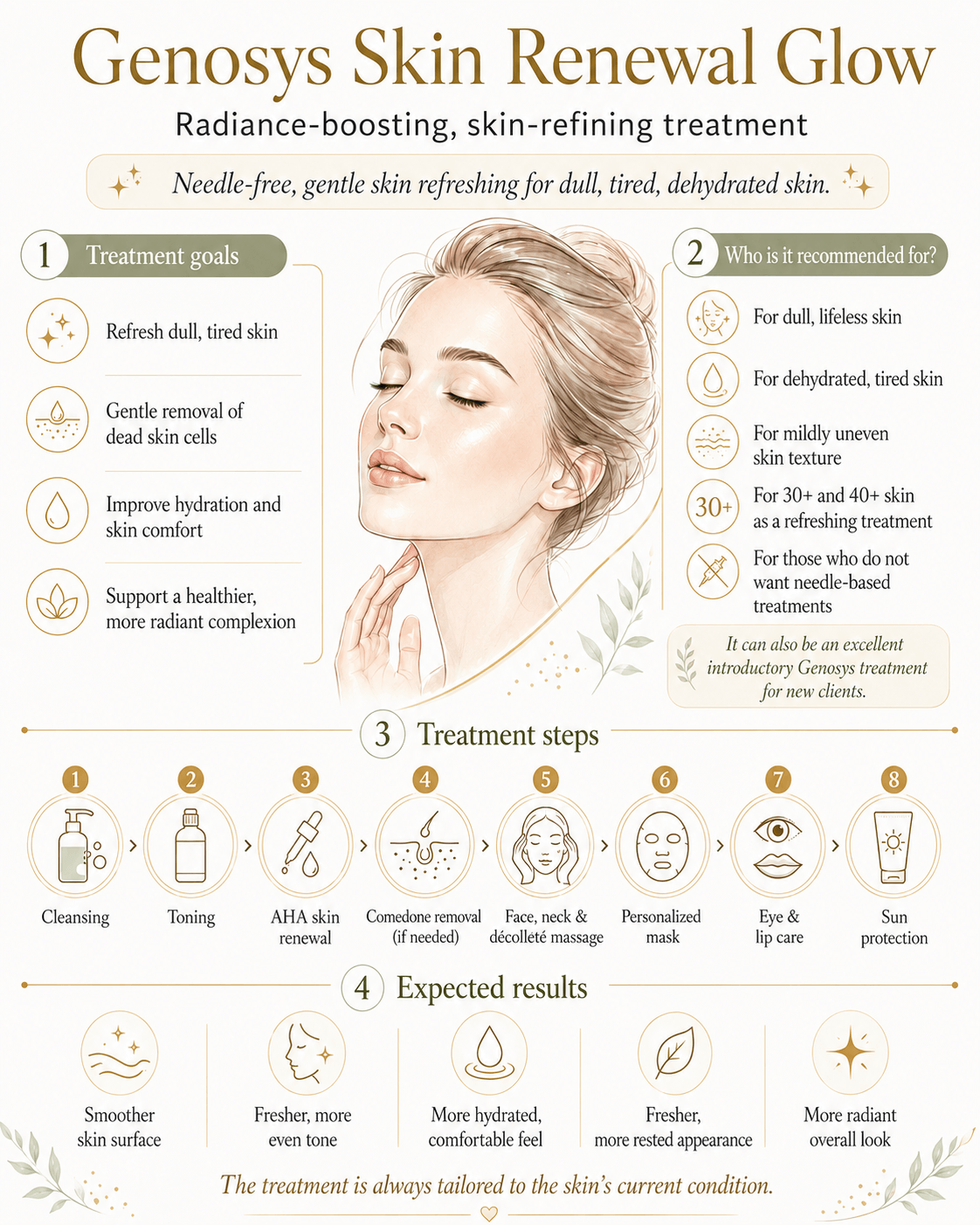
The Genosys Skin Renewal Glow is a gentle, needle-free skin renewal treatment designed to refresh dull, tired skin, refine the skin surface, and support a fresher, brighter, more radiant complexion.
This treatment may be an especially good choice for those who would like a visible skin-refreshing effect but do not wish to have microneedling or spicule-based treatments.
The aim of the treatment
The aim of the treatment is to:
Who is it recommended for?
This treatment is mainly recommended for the following skin conditions:
When is it not recommended?
The treatment is not recommended in the following cases:
In these cases, it is usually better to choose a calming, barrier-supporting treatment adapted to the current condition of the skin.
Treatment steps
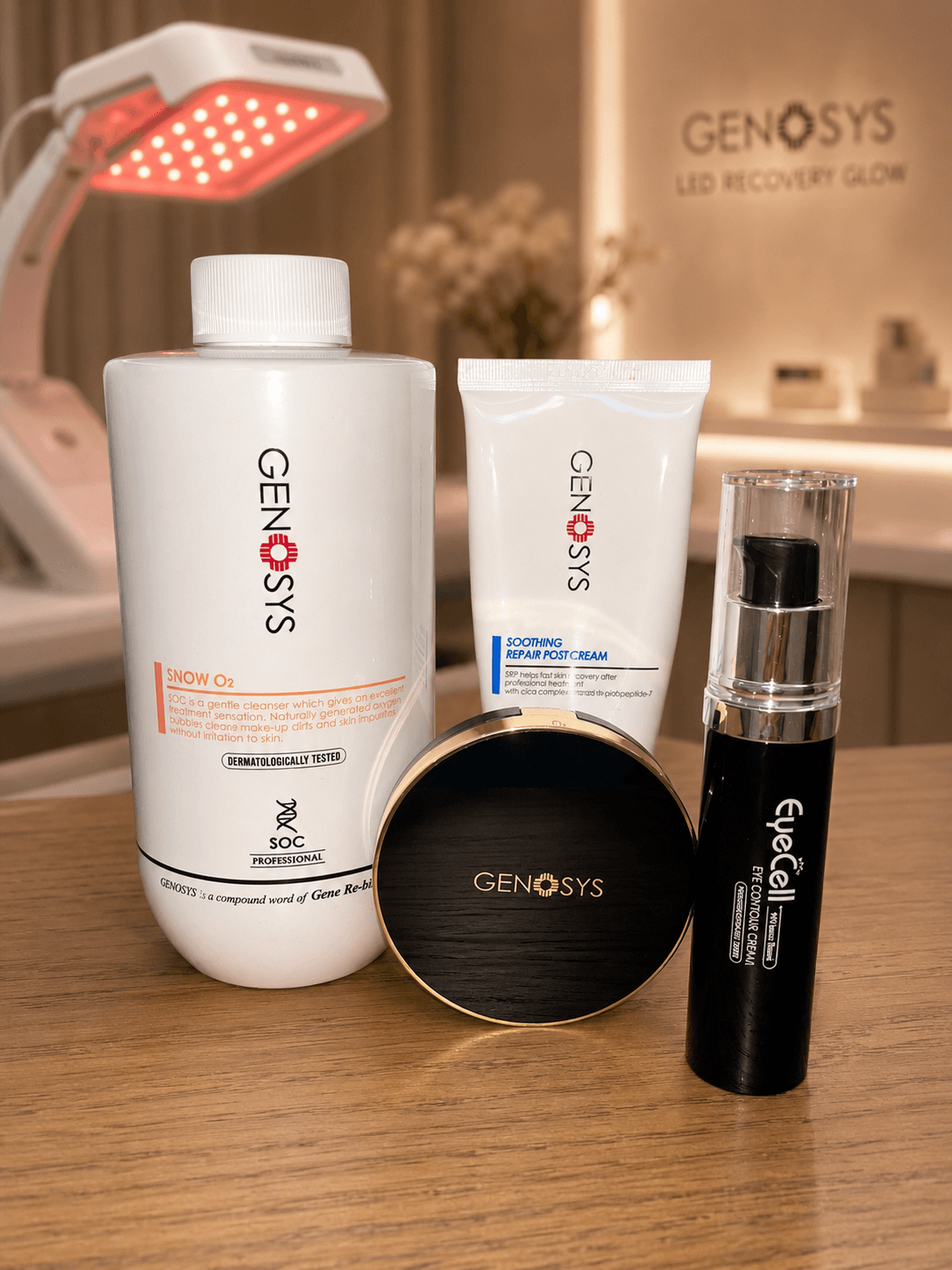
The treatment begins with a gentle oxygen-bubble cleanser. When applied to the skin, the cleanser forms oxygen bubbles that help loosen makeup and impurities, so there is no need for harsh rubbing. This is especially important because the aim is to prepare clean, but not over-cleansed, skin.
The toning step aims to hydrate and soothe the skin and restore comfort after cleansing. It contains ingredients such as Lactobacillus and pumpkin ferment extract, as well as a botanical complex that helps reduce skin irritation and supports a calmer skin feel.
This phase prepares the skin for the next, gentle skin renewal step.
During the treatment, a mild, controlled AHA-based skin renewal step helps refine the skin surface. Alpha hydroxy acids such as lactic acid, glycolic acid and mandelic acid may contribute to smoother, fresher and more radiant-looking skin.
The goal is not aggressive exfoliation, but gentle skin refreshing and the support of a more even-looking complexion.
If necessary, and if the condition of the skin allows it, the treatment may include the careful removal of blackheads and comedones. This step is always skin-condition dependent and is not required in every case.
A pleasant, relaxing massage is an important part of the treatment. Gentle smoothing, lymphatic and relaxing movements performed on the face, neck and décolleté help support a fresher appearance, improve skin comfort and significantly enhance the relaxing, wellness-like character of the treatment.
The mask is always selected according to the current condition of the skin. For dehydrated, tired skin, I use a hydrating and refreshing mask. For more sensitive or redness-prone skin, a soothing and cooling mask is chosen. If the skin needs regeneration, a barrier-supporting and comfort-enhancing mask is applied.
This is what makes the treatment truly personalized: it is not a fixed protocol, but a treatment adapted to the skin’s current needs.
As a delicate complementary step, special attention is given to the eye area and the lips. These areas are thinner and more sensitive, can become dehydrated more easily, and often show signs of fatigue sooner.
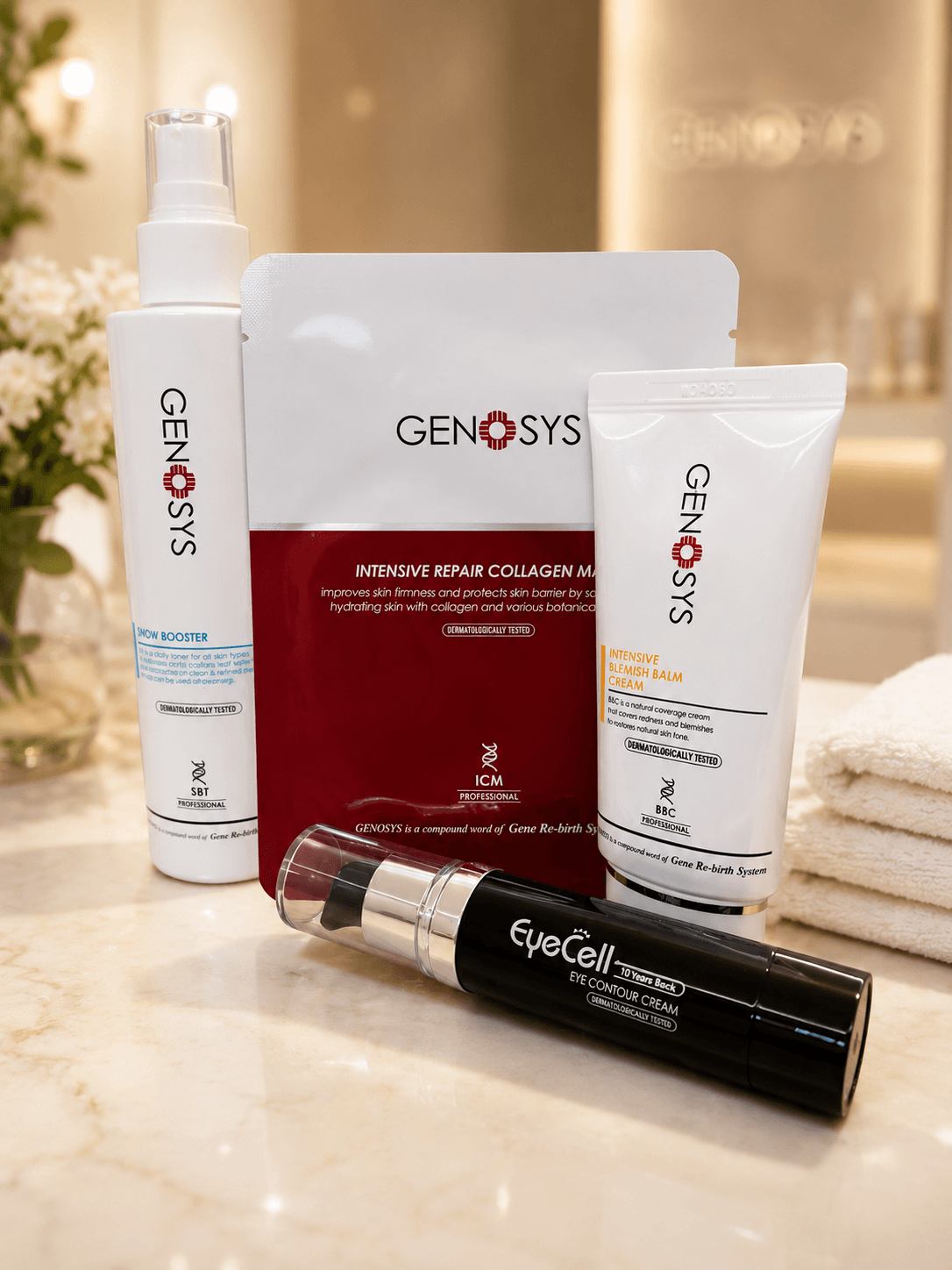
The active ingredients in the targeted eye-care product include peptides that support collagen synthesis, as well as chrysin, which is used to help reduce the appearance of dark circles. The aim is to leave the eye area feeling more hydrated, fresher and brighter.
At the end of the treatment, the skin is protected with sunscreen, as UV protection is especially important after skin-renewing treatments.
The finishing product is always selected according to the guest’s needs and the current condition of the skin. If the guest prefers a light, natural finish, I apply a high-protection sunscreen. If light coverage and a more even-looking complexion are desired, a BB cream-type sunscreen may also be chosen.
This way, at the end of the treatment, the skin receives not only protection, but also leaves looking fresher, more refined and more balanced.
Duration: 90 minutes
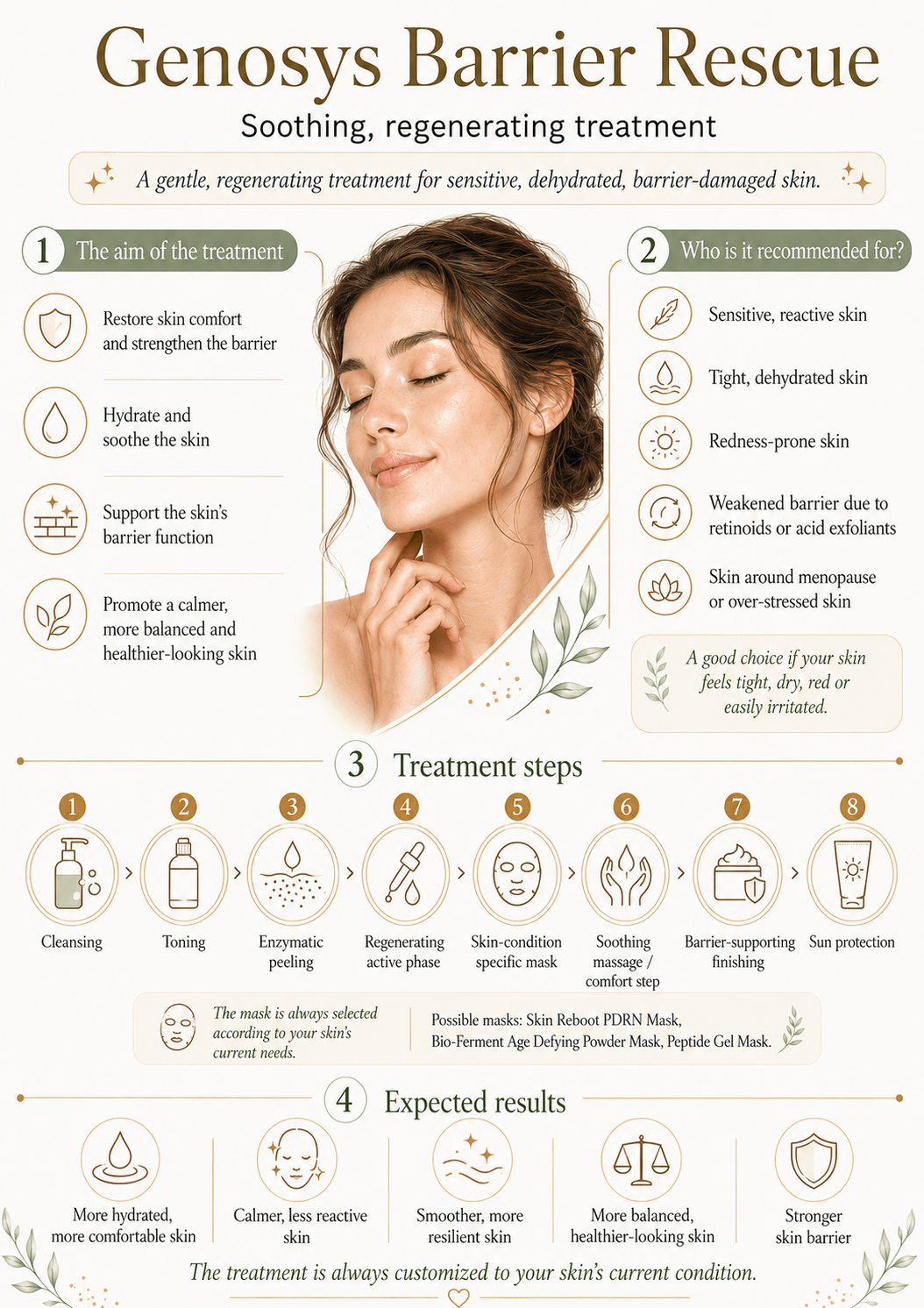
The Genosys Barrier Rescue is a gentle, regenerating treatment recommended primarily for sensitive, tight, redness-prone, dehydrated or over-stressed skin. The aim of the treatment is not intensive exfoliation or strong stimulation, but rather to restore skin comfort, improve hydration and support the skin’s protective barrier.
The skin’s protective layer, also known as the barrier, plays an important role in helping the skin retain moisture, become more resistant to external environmental stressors and react less easily with irritation. When this protective barrier becomes weakened, the skin may more easily feel tight, become red, sensitive or dehydrated.
The treatment can be especially beneficial when the skin has become more sensitive, dry or tight due to frequent acid exfoliation, retinoid use, weather changes, the heating season, post-sun dehydration or hormonal changes.
The aim of the treatment
The aim of the Genosys Barrier Rescue treatment is to:
This treatment is not a classic exfoliating protocol, but rather a comfort-restoring, regenerating skincare programme.
Who is it recommended for?
This treatment is mainly recommended for the following skin conditions:
It can also be a good choice for those who feel that their skin “cannot tolerate” another strong active ingredient or intensive exfoliation, and instead needs calmness, hydration and gentle care.
When is it not recommended?
The treatment is not recommended, or should be postponed, in the following cases:
In the case of severely inflamed, painful or suddenly worsening skin conditions, a dermatological consultation is recommended first.
Treatment steps
The treatment always begins with an assessment of the skin’s current condition. I check how sensitive, redness-prone, dehydrated or irritated the skin is, and we also discuss the guest’s home skincare routine.
Special attention is given to whether the guest uses acid exfoliants, retinoids, stronger vitamin C products, benzoyl peroxide or other active ingredients, as these may influence skin sensitivity and the structure of the treatment.
The treatment starts with gentle cleansing that minimizes irritation. The aim is to remove makeup, sebum and impurities without further compromising the skin’s protective barrier.
In the case of sensitive or barrier-damaged skin, it is especially important that even the cleansing step is not harsh or abrasive. The goal is to make the skin clean, but not over-cleansed or dried out.
The toning step aims to hydrate and soothe the skin and restore comfort after cleansing. This phase is performed with gentle pressing motions, without rubbing.
The Genosys Barrier Rescue treatment is not an intensive exfoliating treatment. Therefore, instead of acid exfoliation, I use a gentle enzymatic peeling in this step. The aim is to delicately remove dead skin cells without exposing the skin to further irritating stress.
The enzymatic peeling contains papaya, moringa and other botanical extracts that help gently refresh the skin surface. The product also contains hydrating ingredients, as well as soothing and irritation-reducing botanical extracts, making it well suited to sensitive, dehydrated or over-stressed skin.
In this protocol, the purpose of the peeling is not visible peeling or intensive exfoliation, but gentle preparation of the skin for the regenerating and barrier-supporting steps.
In the next step, hydrating, soothing and regenerating Genosys active ingredients come into focus. The aim is to support the skin’s moisture content, reduce the unpleasant feeling of tightness and strengthen the barrier function.
In this treatment, the main goal is not active stimulation, but protection and calming of the skin. Therefore, the choice of active ingredients is always adapted to the current condition of the skin.
One of the central steps of the treatment is the application of a personalized mask. The mask is always selected according to the guest’s current skin needs.
The Genosys Skin Reboot PDRN Mask fits particularly well into this treatment because it contains PDRN, panthenol, ceramides and phytosphingosine. These ingredients are closely connected to supporting skin hydration, regeneration and the protective barrier.
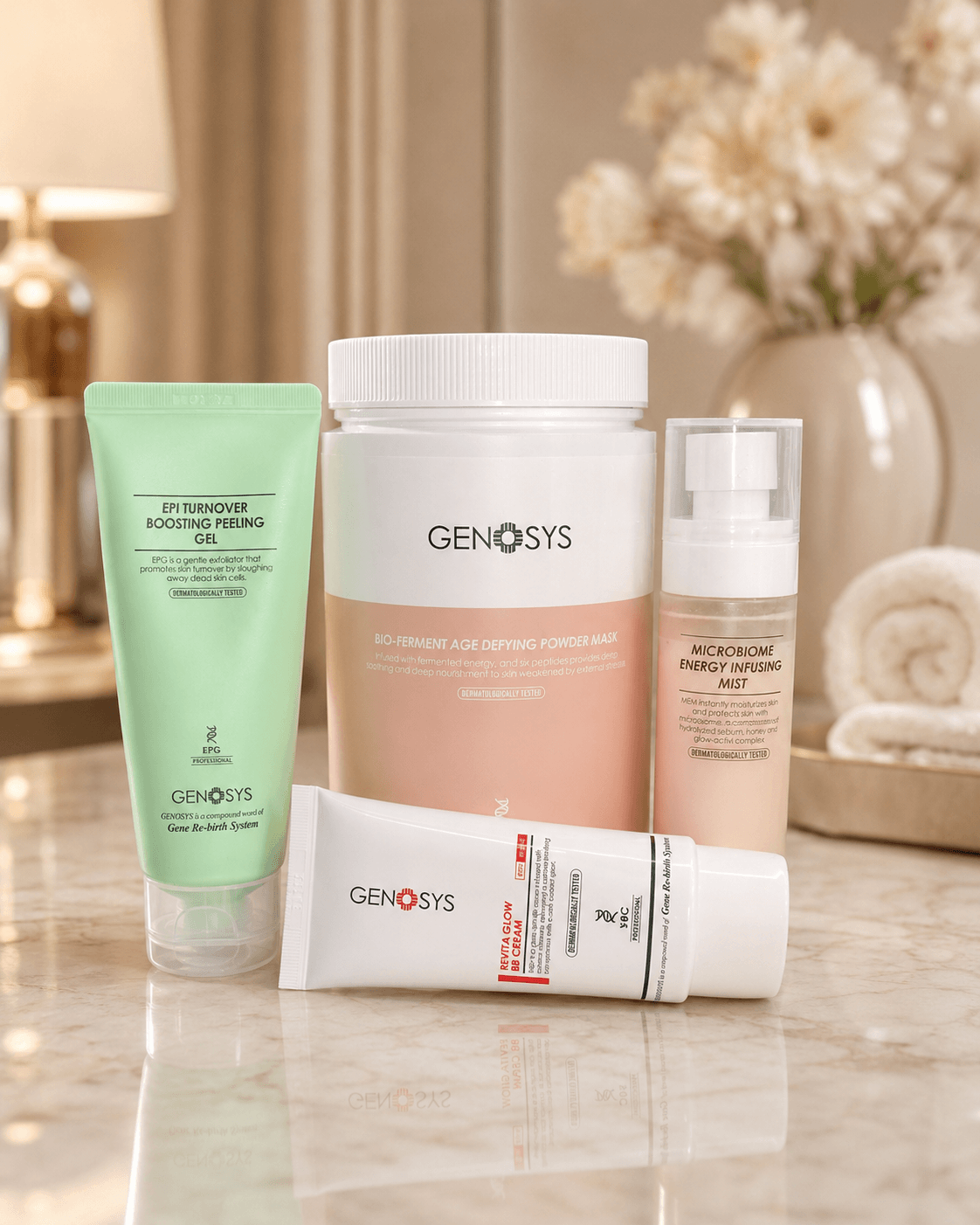
As an alternative, the Genosys Bio-Ferment Age Defying Powder Mask may also be used. It is based on fermented ingredients and a moisture-retaining, nourishing mask base. This mask can be an especially good choice for tired, dehydrated, more sensitive skin or skin stressed by external factors, when the aim is to soothe the skin, improve comfort and support regeneration.
For more sensitive skin that needs a cooling effect, the Peptide Gel Mask or another soothing-type mask may also be selected.
In the Barrier Rescue treatment, massage is not always necessary. If the skin is very red, burning or highly reactive, I leave out the massage and instead use calming compresses or gentle pressing techniques.
If the condition of the skin allows it, a short, very gentle soothing massage may be performed on the face, neck and décolleté. In this case, I avoid strong kneading, pinching or intensive lifting movements. The aim is not to overstimulate the skin, but to improve comfort and enhance the relaxing character of the treatment.
At the end of the treatment, a soothing, regenerating and barrier-supporting cream is applied to the skin. Its ceramide, Centella asiatica and macadamia seed oil content helps retain hydration, reduce the feeling of tightness and support the restoration of the skin’s protective barrier.
The finishing cream is always selected according to the current condition of the skin: richer textures may be used for drier skin, while for more sensitive or easily reddened skin, a particularly soothing and comfort-enhancing formula is preferred.
During daytime, the treatment is finished with sun protection. UV protection is especially important for sensitive or regenerating skin, as a weakened skin barrier may react more easily to external environmental factors.
The finishing product is selected according to the guest’s needs and the condition of the skin. If the aim is light, natural protection, I apply a high-protection sunscreen. If the guest would also like light coverage and a more even-looking complexion, a BB cream-type finish may be chosen.
Home care after the treatment
After the Genosys Barrier Rescue treatment, the purpose of the home routine is to continue soothing, hydrating and supporting the skin barrier.
For 24–48 hours after the treatment, it is advisable to avoid:
Recommended home routine:
If the skin feels tight, tense, red or irritated, it is worth simplifying the home routine temporarily: gentle cleansing, hydration and sun protection. Too many active ingredients at this stage do not support the skin; they may place further stress on it.
Duration: 90 minutes
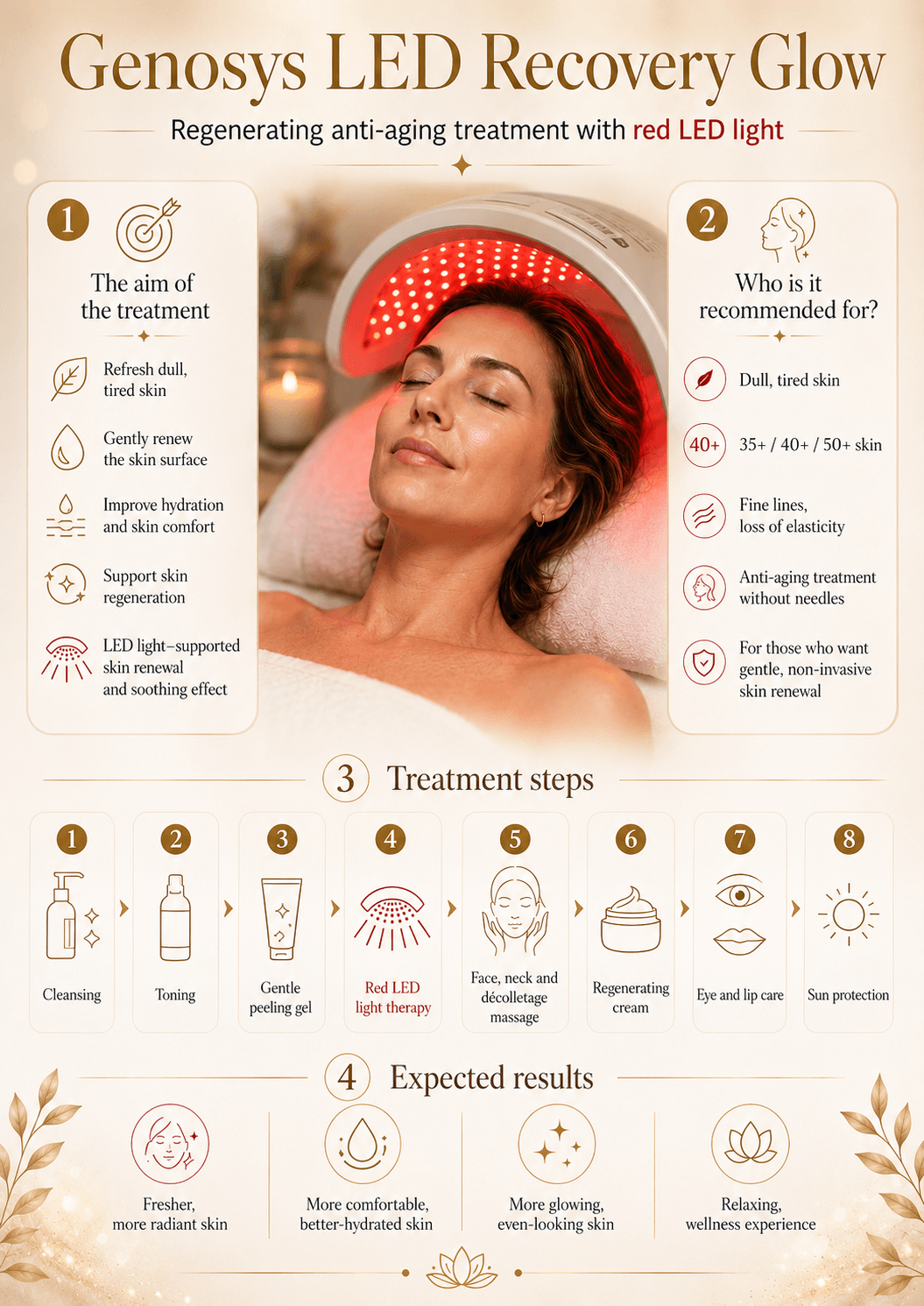
The Genosys LED Recovery Glow is a needle-free, regenerating anti-aging treatment that combines Genosys skin-refreshing and hydrating steps with red LED light therapy. The aim of the treatment is to refresh dull, tired, dehydrated or more mature skin, improve skin comfort and support regeneration.
In cosmetic treatments, red LED light can be used as a complementary method to support skin renewal and regeneration. When applied as a course of treatments, it may contribute to a fresher, more radiant and more balanced-looking complexion. The treatment is non-invasive, does not involve needles, and fits well into skin-refreshing protocols where the goal is gentle stimulation, soothing and hydration.
The aim of the treatment
The aim of the treatment is to:
This treatment may be an especially good choice for those who would like an anti-aging approach, but prefer a gentle, needle-free skin-refreshing treatment.
Who is it recommended for?
The treatment is mainly recommended for the following skin conditions:
The treatment may also be a good choice when the skin looks more tired or dull, but a more intensive or invasive skin-renewing procedure is not necessary or not desired.
When is it not recommended?
The treatment is not recommended, or should be postponed, in the following cases:
Before the treatment, it is always important to assess the current condition of the skin and discuss any possible contraindications.
Treatment steps
The treatment begins with a gentle oxygen-bubble cleanser. The naturally forming oxygen bubbles help loosen makeup, sebum and impurities, so there is no need for harsh rubbing.
The aim is to prepare skin that is clean but not over-cleansed, which is especially important before skin-refreshing and LED light therapy steps.
The toning step aims to hydrate and soothe the skin and restore comfort after cleansing. This phase prepares the skin for the next, gentle skin-surface refreshing step.
In this treatment, dead skin cells are removed with a quick, gentle, rinse-off peeling gel. The aim is to delicately refresh the skin surface, soften the skin texture and support a fresher, smoother skin feel.
This step does not work as aggressive exfoliation. Instead, it prepares the skin for LED light therapy and regenerating care. The use of the peeling gel is always adapted to the current condition of the skin.
One of the central elements of the treatment is red LED light therapy. From an anti-aging perspective, red LED light can be used to support skin regeneration, freshness, comfort and overall skin quality.
Red and near-infrared light can support mitochondrial function, which may increase ATP production, the energy supply of the cell.
This gentle cellular stimulus is not a heating or damaging effect, but rather a low-energy regulatory signal. The signalling processes triggered by this light stimulus may influence inflammatory responses, regeneration, fibroblast activity and processes related to collagen production. This is why red LED light is used in anti-aging treatments to support skin quality, regeneration, comfort and a fresher-looking complexion.
Eye protection is required during the LED treatment.
After red LED light therapy, a pleasant hydrating massage follows on the face, neck and décolleté. Slow smoothing movements, gentle lymphatic techniques, jawline smoothing, cheek-lifting but not strong kneading movements, as well as soft relaxation of the forehead, neck and décolleté all contribute to the comforting and relaxing character of the treatment.
The aim of the massage is to support a fresher appearance, improve skin comfort and enhance the wellness value of the treatment. The massage movements are always adapted to the current condition of the skin; for more sensitive skin, the massage is shorter and gentler.
At the end of the treatment, a soothing, regenerating cream is applied to the skin. This step helps comfortably complete the combination of peeling, LED light therapy and massage.
The purpose of the regenerating cream is to help maintain hydration, improve skin comfort and support the barrier. The finishing product is always selected according to the current condition of the skin.
As a delicate complementary step, special attention is given to the eye area and the lips. These zones are thinner and more sensitive, can become dehydrated more easily, and often show signs of fatigue sooner.
Targeted care helps the area feel more hydrated, fresher and more comfortable, while contributing to a fresh and harmonious overall appearance.
During daytime, the treatment is finished with sun protection. After skin-refreshing treatments combined with LED therapy, UV protection is especially important, particularly for pigmentation-prone or more sensitive skin.
The finishing product is always selected according to the guest’s needs and the current condition of the skin. If the guest prefers a light, natural finish, I apply a high-protection sunscreen. If light coverage and a more even-looking complexion are desired, a BB cream-type sunscreen may also be chosen.
This way, at the end of the treatment, the skin receives not only protection, but also leaves looking fresher, more refined and more balanced.
Home care after the treatment
After the treatment, the aim of the home routine is to soothe and hydrate the skin and ensure proper sun protection.
For 24–48 hours after the treatment, it is advisable to avoid:
Recommended home routine:
Duration: 90 minutes
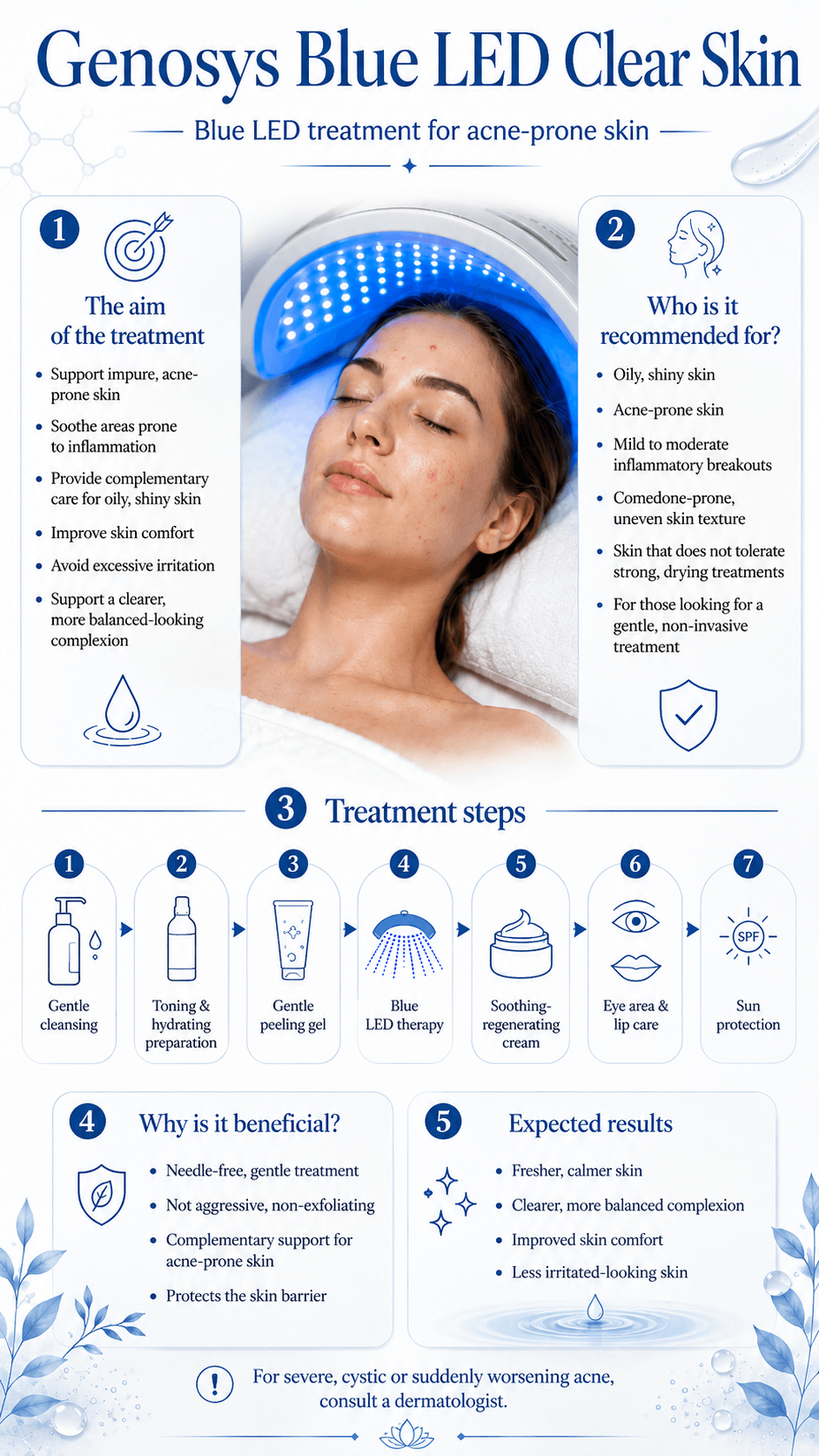
The Genosys Blue LED Clear Skin is a gentle light therapy treatment recommended primarily for oilier, impure and acne-prone skin. The aim of the treatment is to care for problematic skin in a gentle way, soothe areas prone to inflammation, and support a clearer, more balanced-looking complexion.
The cosmetic significance of blue LED light lies in its ability to act on the light-sensitive porphyrins produced by Cutibacterium acnes, a bacterium involved in the development of acne. Blue light can activate these molecules, which may lead to the formation of reactive oxygen species. This process can create an unfavourable environment for the bacteria, making blue LED treatment a useful complementary method in the care of acne-prone, inflammation-prone skin.
It is important to note, however, that blue LED treatment does not replace dermatological treatment in cases of severe, scarring or suddenly worsening acne. In such cases, a dermatological consultation is recommended.
Why can it be useful for acne-prone skin?
The care of acne-prone skin is not only about “drying out” the skin. Strong, irritating active ingredients often worsen skin comfort, may weaken the protective barrier, increase redness and make the skin more sensitive.
The advantage of blue LED treatment is that it is non-invasive, does not involve needles, does not aggressively exfoliate the skin, and can be well integrated into a gentle treatment programme for problematic skin. The aim is not to over-dry the skin, but to support the condition of impure, acne-prone skin while also paying attention to barrier protection and skin comfort.
The treatment can be especially useful as a course of treatments. Even after one session, the skin may feel fresher and calmer, but in acne-prone skin, longer-lasting results usually require several treatments, a consistent home skincare routine and, when necessary, dermatological cooperation.
The aim of the treatment
The aim of the treatment is to:
Who is it recommended for?
This treatment is mainly recommended for the following skin conditions:
In adult acne, it is especially important to assess the skin condition carefully, as inflammation, dehydration, barrier damage and hormonal factors are often present at the same time.
When is it not recommended?
I do not perform the treatment, or I recommend prior medical consultation, in the following cases:
Treatment steps
The treatment begins with a gentle oxygen-bubble cleanser. The naturally forming oxygen bubbles help loosen makeup, sebum and impurities, so there is no need for harsh rubbing.
The aim is to prepare a clean but not over-dried skin surface. In acne-prone skin, it is especially important that cleansing is thorough but does not further damage the skin’s protective barrier.
The toning step aims to hydrate and soothe the skin and restore comfort after cleansing. This phase helps prepare the skin for the following treatment steps.
Even in problematic skin, excessive drying is not the goal. Dehydrated, irritated acne-prone skin often reacts more sensitively, so barrier-friendly care is an important part of the treatment.
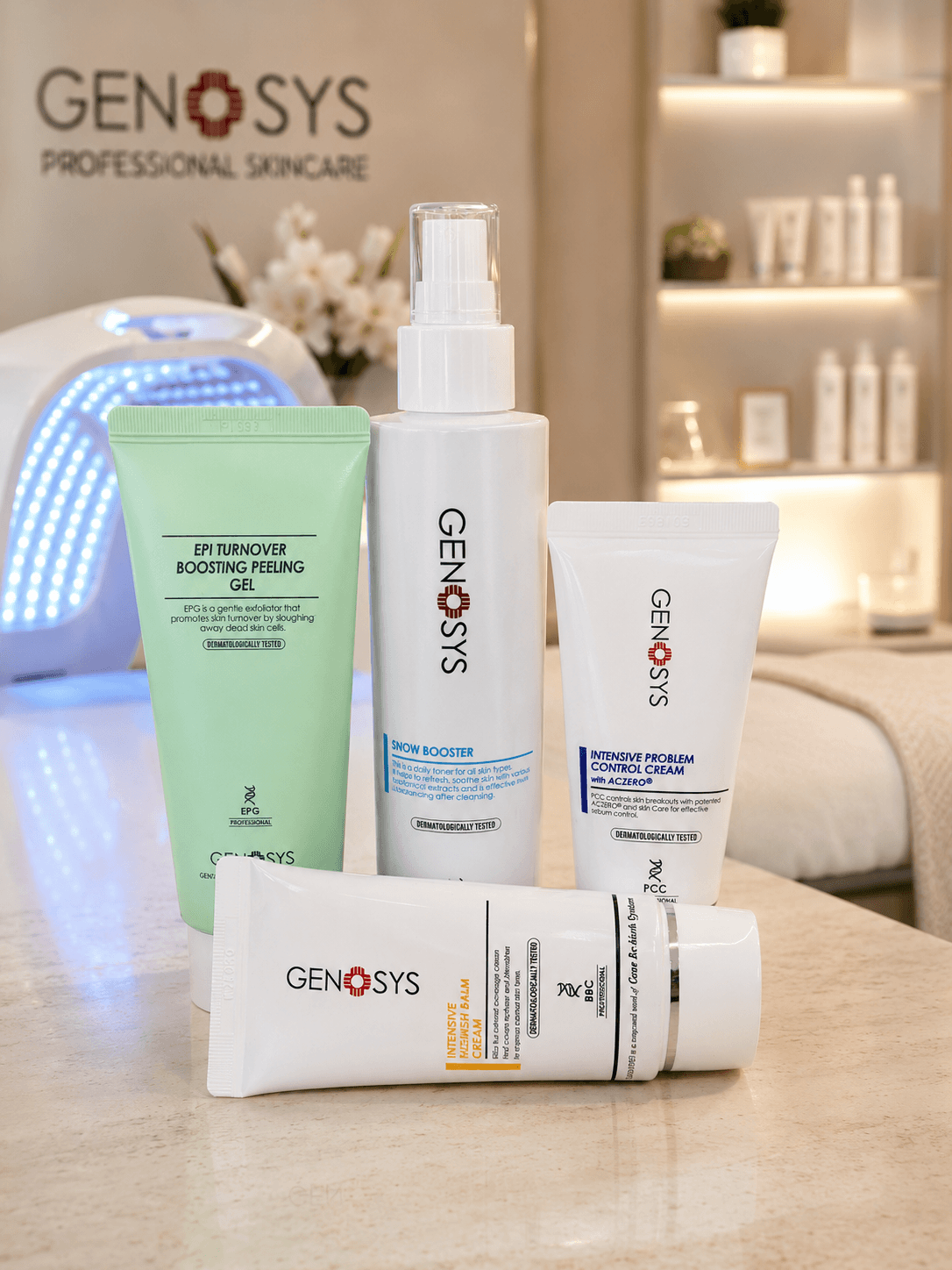
If the condition of the skin allows it, dead skin cells are removed with a quick, gentle, rinse-off peeling gel. The aim of this step is to lightly refresh the skin surface, improve skin texture and support a fresher, smoother skin feel.
In the case of inflamed, painful or highly irritated acne-prone skin, I leave this step out, as the skin then needs soothing rather than mechanical or exfoliating stress.
The central step of the treatment is blue LED light therapy. Blue LED light can be used as a complementary treatment for acne-prone skin, as it may act on the light-sensitive porphyrins produced by Cutibacterium acnes.
Eye protection is required during the LED treatment.
After blue LED light therapy, a soothing, regenerating cream is applied to the skin. Among its ingredients, zinc PCA helps reduce sebum production, trehalose supports skin hydration, while panthenol and beta-glucan provide an anti-inflammatory and calming effect.
As a delicate complementary step, special attention is given to the eye area and the lips. These zones are thinner and more sensitive, can become dehydrated more easily, and often show signs of fatigue sooner.
Targeted care helps the area feel more hydrated, fresher and more comfortable, while contributing to a well-groomed, harmonious overall appearance.
During daytime, the treatment is finished with sun protection. Problematic, acne-prone skin also needs UV protection, especially if the treatment included mild peeling or if the skin is prone to post-inflammatory marks.
The finishing product is always selected according to the guest’s needs and the current condition of the skin. If the aim is a light, natural finish, I apply a high-protection sunscreen. If the guest would also like light coverage and a more even-looking complexion, a BB cream-type sunscreen may also be chosen, taking the skin condition into account.
Home care after the treatment
After the Genosys Blue LED Clear Skin treatment, the aim of the home routine is to soothe and hydrate the skin, protect the barrier and provide consistent care without clogging the pores.
For 24–48 hours after the treatment, it is advisable to avoid:
Recommended home routine:
Problematic skin responds best when salon treatment and the home routine support each other. For this reason, every treatment includes home care advice tailored to the current condition of the skin.
Duration: 90 minutes
Stop guessing – come in for a professional skin diagnostic, and I’ll show you how to achieve a radiant, healthier complexion.
